How To Replace X-Axis Cable Protector on HAAS TM-1 CNC Milling Machine.
Updated: 19 hours ago
Both my 2005 HAAS TM-1 and 2010 HAAS TM-1 arrived with broken X-axis cable protector conduit. Given that the 2010 HAAS TM1 had only 28 hours of run time, these cable protector housings seem like a weak point.
Once these cable housings tear, chips and coolant can work their way in and damage the cables. A broken cable housing also makes the cable bend sharply and no longer relieves bending strain.
It's almost impossible to replace the cable protector conduit housing because it is not much larger than the cable bundle it protects, and the end connectors are huge. You would have to disassemble the connectors, pull out all the pins, remove the broken cable protector conduit, replace it with a new one, then reinstall the pins and reassemble the connectors. That would be a nightmare.
The largest connector measures just over 2.5 in at its widest. That means that it could fit through a 2.75 in tube without any issues. Therefore, a 2.75 in or 3 in reinforced hose is a good candidate for covering and protecting the cables. It will also be easier to replace in the future when it inevitably tears.
The hose must be abrasion resistant.
The minimum bend radius (inner) will be about 9-10in. Here's an example of a 3in hose with the table all the way to the back.

The hose must resist hot metal chips, so it must use the right heat-resistant material. McMaster offers a high-temperature flexible duct hose for dust with 300°F heat resistance. It is made from neoprene-coated fiberglass.
High-Temperature Flexible Duct Hose for Dust 3" ID, 3-1/8" OD
Wall thickness = 0.024in
PROS
High temp - 300F heat resistance for hot metal chips
Made of fiberglass coated with neoprene. These are tough materials.
CONS
Unknown abrasion resistance of the exterior. It will be dragged through the pan with metal chips.
Not transparent. Difficult to inspect for chips or coolant inside.
This is the 2.75in ID version.

This is the 3in ID version. It is cheaper than the 2.75in version.

Is It Suitable?
Although it has better heat resistance, it's not as good as polyurethane hoses for use in a CNC milling machine.
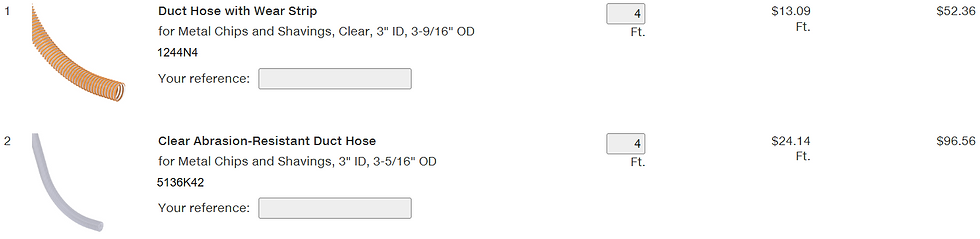
Duct Hose with Wear Strip for Metal Chips and Shavings, Clear, 3" ID, 3-9/16" OD
This hose claims to have high wear resistance because it is made from polyurethane rubber with a plastic spiral. It claims that the polyurethane rubber.
Wall Thickness = 0.033in
PROS
Good abrasion resistance.
Transparent
Thicker wall than the neoprene/fiberglass
No metal wire. The spiral is plastic and acts as a wear strip.
CONS
Only 200°F temperature resistance vs 300F of the neoprene and fiberglass hose
Plastic spiral. No metal wire. The existing conduit also has a plastic spiral. It appears that the plastic spiral fails at points of high constant stress (bends), breaks and then tears the rubber. Metal wires won't break under static bending stress below their yield strength.

Is It Suitable?
Yes, but I am concerned about the plastic spiral vs a metal spiral for when it's being held in a constant bend position.
Clear Abrasion-Resistant Duct Hose for Metal Chips and Shavings, 3" ID, 3-3/8" OD
This is also available in black, but clear lets you inspect it visually, which is a clear advantage.
Wall Thickness = 0.035"
PROS
Good abrasion resistance.
Transparent
Thicker wall than the neoprene/fiberglass
0.035 in
0.06 in
CONS
Only 200°F temperature resistance vs 300F of the neoprene and fiberglass hose
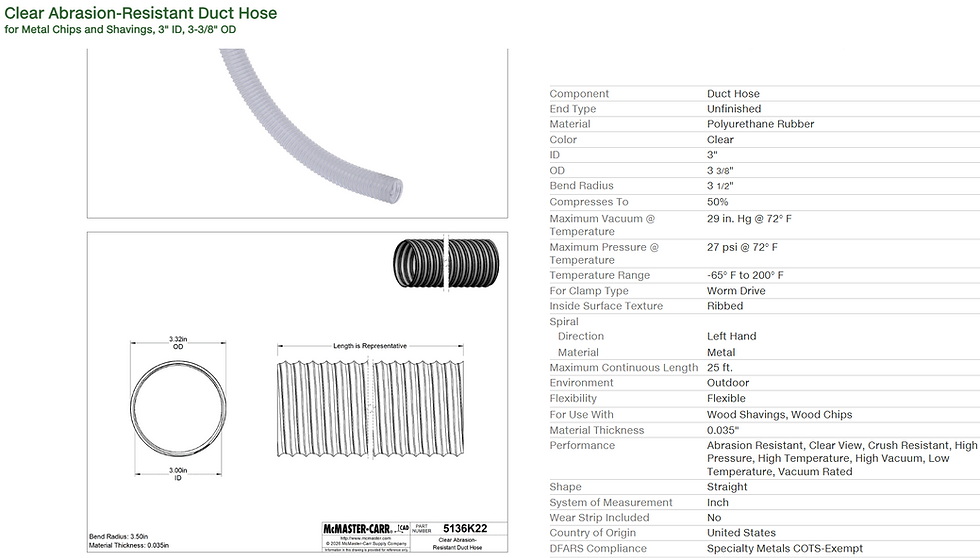
This one has a thicker wall, so it should be more durable. However, it is less flexible, which could lead to higher stress when bending close to the minimum bend radius. The higher stress could lead to earlier failure.

Is It Suitable?
Yes. The only concern is that the outer layer could wear through, exposing the metal spiral. The thicker-wall version should reduce the risk. The metal spiral wire will be more durable than the plastic spiral.
POLYURETHANE VS NEOPRENE FOR USE IN A CNC MILLING MACHINE (AI Answer):
1. Resistance to CNC Coolants & Cutting Oils
Polyurethane (Winner): Polyurethane has exceptional resistance to petroleum-based cutting oils, synthetic lubricants, and industrial greases. It will not swell, soften, or degrade when saturated with standard machine shop fluids. [1, 2, 3]
Neoprene: While neoprene has "moderate" oil resistance, it will gradually swell, break down, and lose its physical shape when subjected to continuous submersion or heavy pooling of modern CNC coolants and tramp oils.
2. Resistance to Mechanical Wear and Hot Swarf
In a CNC machine, chemical exposure happens simultaneously with intense mechanical abuse.
Polyurethane (Winner): It possesses incredible abrasion and tear resistance. When used as a way wiper, it can scraped across sharp metal chips (swarf) and rough casting surfaces thousands of times without tearing or dulling its sealing edge.
Neoprene: It tears much more easily under mechanical stress. If a sharp aluminum or steel chip gets caught under a neoprene wiper, the chip will easily gouge or slice the material, ruining the seal and letting coolant leak into vital machine components.
3. Resistance to Hydrolysis (Water-Soluble Coolants)
Polyurethane: Note that you must specify Polyether-based polyurethane for a CNC machine. Polyether formulations are highly resistant to water and humidity, meaning they won't break down chemically (hydrolyze) when exposed to water-soluble coolants.
Neoprene: Neoprene handles plain water well, but the combination of water, specialized chemical additives in coolants, and constant friction shortens its operational life significantly compared to PU.
HOSE SELECTION CONCLUSION:
I have to do this on 2 machines, so I'll choose 2 different hoses to compare. That way, when one fails, I only need to replace one.
3D PRINTED HOSE END ADAPTERS
Special adapters will need to be designed for both hose ends.
Need to fit around cables
Waterproof the ends of the hose
Hose clamps onto them.
Integrated clamp
Hose clamp
Durable in a CNC milling machine environment.


Comments