Li-ion and Li-Po Battery Safe Charging and Storage solutions for preventing fires and reducing toxic fumes for Lithium Ion and Polymer Batteries
Updated: Sep 4
DISCLAIMER:
The following info is documentation for scientific research purposes only. Do not attempt to recreate any of the equipment described. We are not responsible for any damage caused by information documented here. Read at your own risk.
DESIGNING A LITHIUM ION CHARGING CABINET
Lithium-ion battery charging cabinets that can contain a fire and smoke from a battery catching fire are very expensive... for good reason. It's very difficult to contain and prevent the spread of a lithium-ion battery fire, and even more challenging to block, filter, or exhaust the toxic fumes.
The most promising "passive", no-maintenance solutions are those created by CellBlock, using their expanded glass granule media. This media can encapsulate and extinguish the fire and block the smoke. The media doesn't expire, unlike other fire extinguishers and carbon-based filtration systems. Cellblocks' solution seems like a good compromise for stopping a battery fire and preventing it from spreading to other batteries.
Here are some videos of how it works:
Cabinet
E-bike battery charging rack
Cabinet interior screenshot from the CellBlock video and assumptions about the internal components. No claims are made as to the accuracy of these details; they are merely assumptions based on observation.

Commercial use by a business can justify and write off the cost of a Lithium-ion charging and storage cabinet. The cost may be out of reach for the average non-business homeowner, so they are unlikely to afford protection like this. Therefore, homeowners remain at risk of lithium-ion battery fires from consumer goods, especially lithium-polymer packs used for RC, airsoft, and other hobbies. There are a plethora of inexpensive fiberglass-based pouches, but they will only slow the fire down. It eventually gets through those bags.
CellBlock sells the CellBlock EX expanded glass granule media in small to large bulk bags. These can be used as a firefighting agent by dumping the contents on a Li-ion fire, or to create custom safety enclosures. Cellblock EX media is affordable, so we're going to design a DIY cabinet based on the CellBlock EX media used to stop Li-ion battery fires.
Screenshot from the Cellblock video showing close-up detail of the Cellblock EX media.

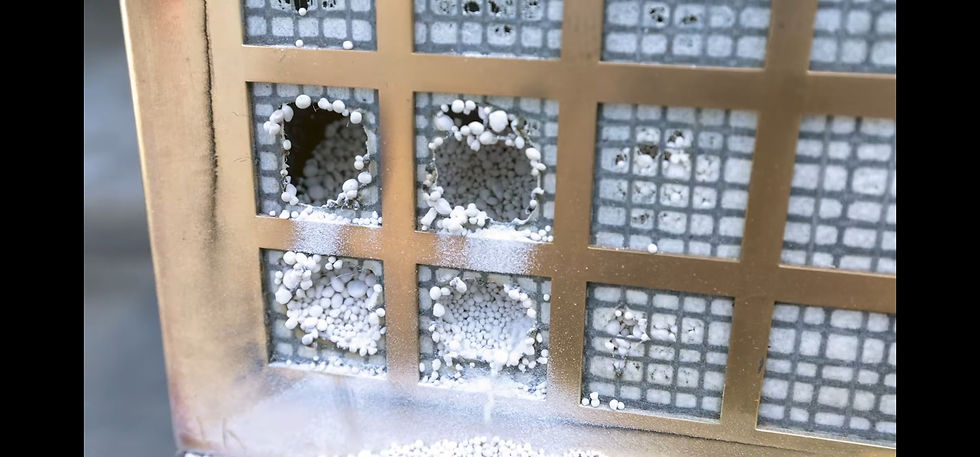
Screenshot from the Cellblock video showing the mesh burned through and the Cellblock EX media deployed through the holes.
Screenshot from the Cellblock video showing the cartridges being filled with media.

We're going to use an off-the-shelf enclosure as a base to modify into the Lithium Ion charging and storage cabinet. In this case, I've selected the high-quality, inexpensive US General tool chest sold by Harbor Freight. It's a well-built, solid cabinet with good-quality drawers.
This is how the stock cabinet appears.

The deep drawers are the perfect height and size for charging and storage.
The shallow drawers are perfect for storing the CellBlock EX media that can fall into and fill the deeper drawers in the case of a lithium battery fire.
The first modification is to reorganize the drawers such that there's a shallow drawer directly above each deep drawer. Fortunately, a deep drawer is exactly twice the height of a shallow drawer, and the cabinet is predrilled for full-drawer-slide mounts, so the drawers can be placed at any position in the cabinet.

The shallow drawers will need to be modified to dispense the CellBlock EX media. There are several different ways this could be done.
Cut large holes in the bottom of the drawer. Place a mesh, such as expanded steel, at the bottom of the drawer. Place a layer of thin sheet plastic that will melt when exposed to heat and flames. Fill with CellBlock EX. Cover with a fireproof, insulating layer, like ceramic wool or cement board.
Cut a grid of many small holes into the bottom of the drawer. (Lots of work without a CNC). Place a layer of thin sheet plastic that will melt when exposed to heat and flames. Fill with CellBlock EX. Cover with a fireproof, insulating layer, such as ceramic wool or cement board.
Cut large holes in the bottom of the drawer. 3D-print cartridges that can be filled with CellBlock EX. The bottom of the cartridge has a grid pattern with thin areas that will melt quickly and dispense the CellBlock EX. This approach is modular and contains the CellBlock EX media.
Fireproof, insulating drawer dividers should be used in the deep drawers. This will isolate the batteries from each other and reduce the risk of a chain reaction.
The drawers are self-locking, but it is just a simple plastic latch that may not be strong enough to resist the explosion force of a battery. The drawers also have a key lock, which may not be strong enough.
There is a small gap between the drawers that may be large enough to vent gas to prevent pressure buildup.
1 or 2 steel cabinet-style locking doors can be added to the toolbox's face to further enclose the drawers. A carbon filtration system can be added to that door.
AC Power To Drawers
Charging inside a drawer-style cabinet has the complexity of running power to the drawer. Harbor Freight solved that in one drawer of their larger toolbox, using a cable chain that moves when the drawer opens and closes. A piece of sheet metal above the cable chain guides it and prevents it from rubbing on the drawer above. Unfortunately, this doesn't come with the smaller toolbox we are using, and it's not sold separately.

There are some cable chain outlets available designed for drawers, but they're designed to be attached behind the drawer, unlike the HF version that goes in the drawer. There is some space behind the toolbox drawers, so this may actually work great.


The HF-style drag chain installation can be DIY'd with an off-the-shelf 10x15mm drag chain. Need to add a piece of sheet metal (or 3D-printed clips) at the top of the drawer to keep the drag chain from rubbing on the drawer above it.

ENCLOSURES
Ammo Box Style Enclosures
Ammo boxes have been shown to contain lithium-battery fires.
The gasket needs to be removed to allow the box to vent. That means toxic fumes and smoke will still escape and damage the area they affect. Flames can also shoot out of the gap between the body and the lid, burning nearby objects.
Add insulation on the walls using cement wallboard or ceramic wool insulation to reduce the heat transmitted to the outside of the box. Ceramic wool needs to be encapsulated to protect the fibers. A 3D-printed inner box could "encapsulate" the ceramic wool.
Add dividers for multiple batteries. Dividers should be made of a fireproof material, such as cement wallboard or ceramic insulation board.
Add a vent filter to reduce toxic fumes. The vent filter housing and connection need to be made of metal.
Add a layer of CellBlock EX under the lid. 3D-print a cartridge with holes and a thin film that will melt/burn under low heat. Heat and fire from the battery will melt through the film, and the CellBlock EX will fall onto the battery, encapsulating the fire. CellBlock EX also significantly reduces the amount of smoke emitted.
3D-print floor and walls that are filled with CellBlock EX. The 3D print should be thin enough to melt when heated by a battery on fire. The CellBlock EX will provide insulation and encapsulation of the fire.
Standard 50cal Ammo Box
The gasket needs to be removed to allow the box to vent.
Heavy Duty Metal Ammo Can, Tactical Waterproof Lockable Ammo Crate. Outer dimensions measuring 16" x 5-1/2" x 9.25" (L x W x H) and inner dimensions at 14” x 5” x 8.5" (L x W x H). The advantage of this box is that it is shallow, wide, and deep. That makes it easier to use the room inside.

Standard PA120 40mm Ammo Can
18.25" x 6" x 9.75"
Will fit most eBike batteries
Space to line the walls with cement board or insulation.
Can add a container of Cellblock EX under the lid that deploys when a fire occurs and extinguishes it.
The walls can also be made of Cellblock EX, which deploys in the event of a fire.
The gasket needs to be removed to allow the box to vent.

Charging Enclosures That Can Be Improved Upon
There are some existing charging enclosures that can be improved by adding insulation and extinguishing media, such as Cellblock EX.
This Guardme AN9 enclosure is sold as a fireproof charging box. However, it has a few issues that could be improved upon to make it even safer.
It's a single-wall box with no insulation. The box will get so hot that it could ignite surrounding materials, even if the flames are contained.
Add insulation, such as cement board or ceramic fiber, to the interior floor and walls.
There's nothing to extinguish the fire. The batteries will continue to burn until there's nothing left.
Add a container of Cellblock EX media under the lid that deploys the media when there is a fire. The media drops onto the batteries, encapsulating and extinguishing the fire.
There's no filtration of the soot or toxic fumes released.
Add vents with fiberglass filter media like BAT-SAFE.
The vent fan is important for battery cooling, but in the event of a fire, it will increase the rate at which soot and toxic gases are vented. The vent fan should shut down, and the vent should close when the temps reach fire level. The off-gassing should pass through the fiberglass filter vents.

WHERE TO BUY:
FILTERS
The enclosures need ventilation, which also requires filtration to reduce the toxic fumes being vented.
Organic vapor and acid filtration
The canister needs to be metal so that it doesn't melt
Unless kept sealed, the canisters need to be replaced every 1-2 years.
Off-the-shelf filter options


EXTINGUISHING FIRES
CellBlock EX is made from expanded glass granules. When poured on a lithium battery fire, it melts, absorbing energy from the fire, and cools, hardens, and encapsulates the fire, preventing further combustion.
CURRENT BEST, OFF-THE-SHELF SOLUTIONS FOR PORTABLE LITHIUM BATTERY CHARGING AND STORAGE
LOW-COST
Ignore all the inexpensive fiberglass pouches and bags. They will only slow the spread of the fire, giving some extra time to fight it, but they won't stop or prevent a fire.
The best low-cost, off-the-shelf option is BAT-SAFE brand enclosures. This is what I use now for charging smaller batteries and devices.
PROS:
Double-wall metal construction will contain a fire within the specs. Don't put more watt/hrs of batteries in the box than the recommended limit.
The lid has vents with a fiberglass filter. This will remove the soot from off-gassing. It does not filter the harmful gases. The soot is what damages the interior of the room, house, office, or vehicle where the fire happens.
Will prevent the fire from spreading when used correctly.
Portable
CONS:
Does not filter harmful gases. In case of a fire, you still need to move to an area with fresh air, and ventilate the space where the BAT-SAFE is.
Doesn't extinguish the fire. It only contains it. The battery will burn completely, which releases a lot of toxic gases.
WHERE TO BUY:


They also make an XL and XXL version for e-bike batteries.

Affiliate Disclaimer
The products shown here were purchased by me with the intent to use them. I did not receive any free items, and I am not being paid or compensated for this review.
The video, description, and comments may contain affiliate links. If you click on a link, I may receive a commission. Money earned helps to support my channel and bring you more informative videos about engineering, crafting, and DIY.


Comments