How To Make a 3D Printed Sweetgum and Pinecone Picker Upper
Updated: Jun 11
We have a ton of sweetgum balls and pinecones in the yard. Picking them up is a constant chore. Most solutions I've tried pickup everything, which in many cases I want to leave behind the pinestraw and ground cover in areas that don't have grass.
These are some of the things I've tried.
Raking - Whenever I think about why raking doesn't work for this, I'm reminded of the comment I once read "Ya'll will do anything to avoid raking". That's not not true, although the reason is a bit different in this case. This picks up sweetgum balls and pinecones, but also picks up everything else that I don't want to pickup: Pinestraw, leaves, fragile grass, groundcover, etc.
Vacuum - I've tried a gas-powered walk-behind vacuum. Loud, inconvenient and doesn't do a great job of sucking up sweetgum balls in the grass.
Leaf Blower - Works somewhat, but also blows all the ground cover away, like the pinestraw.
Bagging mower - Sorta works. Gets the pine cones, leaves behind a lot of sweetgum balls. Gets too much pinestraw.
Wire roller (nut picker-upper)- This works great for picking up the sweetgum balls and pinecones. Although faster than picking up one by one by hand, it is still a very slow process.
EXISTING PRODUCTS
There are commercially available picker-upper devices that appear to do a great job of picking up sweetgum balls and pine cones. Guess why I never bought one of these... $$$.
Bag-A-Nut appears to have invented the design, and were the only ones that made these for a long time.
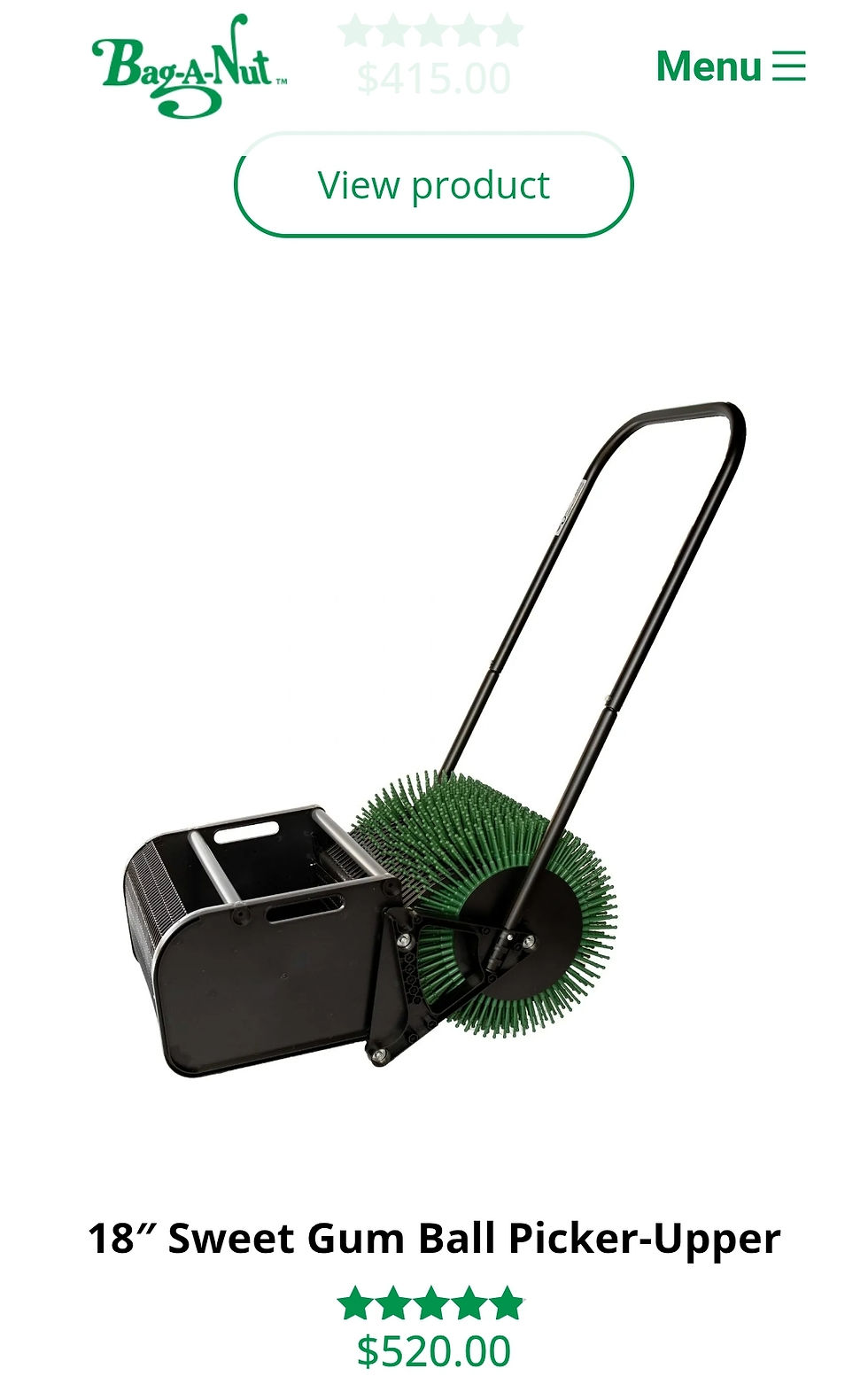
Cyclone Rake came out with their own design, presumably after Bag-A-Nut's patent expired.

PATENTS (Expired)
Bag-A-Nut had a patent on the original design using the tines. That patent expired in 2010. Therefore, it's possible for us to make our own and sell the design, kits or the actual product. Obviously, we can't use any of their trademarks.

DESIGNING A 3D PRINTABLE VERSION
I've been thinking about how to 3D print a DIY picker upper like these for years, but years ago the only printer I had that was large enough to print the tine wheel was the ZORTRAX M200, which has a wall thickness limit of 2 layers. This significantly limits the strength of parts. Although you can print solid, it uses infill to print solid, which is not as strong as thicker layer walls. Now that I have newer printers like Bambu Labs and Snapmaker U1, I can print the tine wheels with enough layers to make the tines solid and strong.
I designed the picker-upper machine in Onshape CAD. I first designed a single tine wheel to print and test to make sure that it would be strong enough for the application before moving further with the design.
I designed it to fit the now standard-ish build plate dimensions of the Bambu printers, so the max diameter of the tine wheel is 10in. This is smaller than the commercial units, which are 12-14in in diameter. The smaller diameter still picks up fine because the tines can be made the same length, but the basket capacity will be lower because the wheel is shorter, so the basket must be shallower.
The tine wheel was printed in PETG and proved to be incredibly strong. I rolled it over some sweetgum balls and pinecones, and it had no issues flexing over them and grabbing them.

Once I proved that the concept worked and the tines were strong, then it was time to print a whole lot of wheels.
FRAME DESIGN
I choose to use 3/4in EMT for the frame because it is inexpensive, readily available, and there are off-the-shelf connectors for it by MAKER PIPE. According to Maker Pipe's blog post about "The Actual Inside & Outside Diameters of Common EMT Conduit Sizes", the actual 3/4 EMT ID is 0.824 inches and OD is 0.922 inches. a
Maker Pipe offers a variety of fittings that we will use to create strong connections for the frame. Link to their Fittings and Accessories page.

Affiliate Disclaimer
The products shown here were purchased by me with the intent to use them. I did not receive any free items, and I am not being paid or compensated for this review. The video, description, and comments may contain affiliate links. If you click on a link, I may receive a commission. Money earned helps to support my channel and bring you more informative videos about engineering, crafting, and DIY


Hello. This is a great project! Is the 3D file for the tines downloadable?